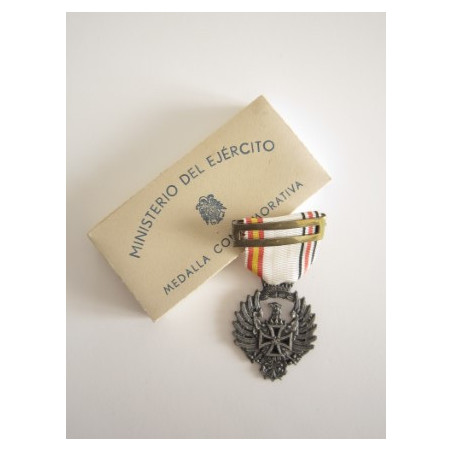
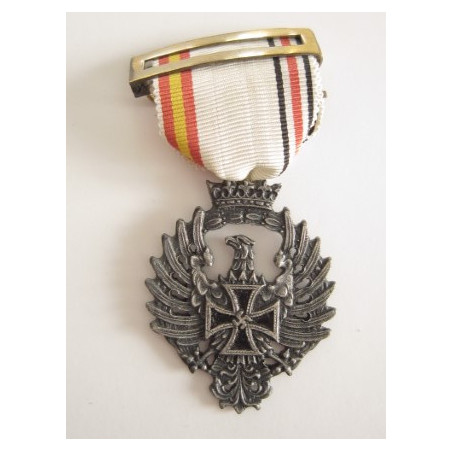
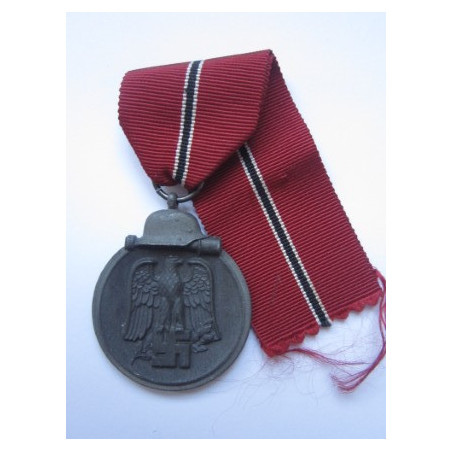
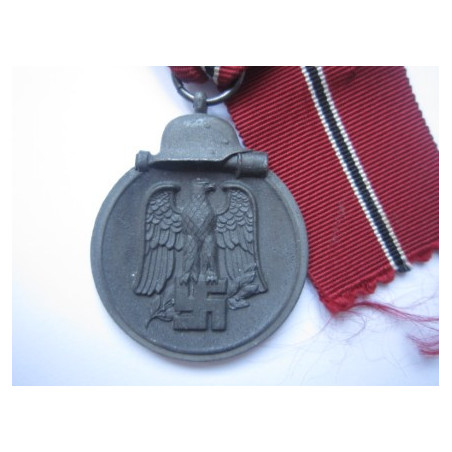
The Spanish Volunteer Division, known as the Blue Division (División Azul), was the unit of Spanish volunteers that fought on the Eastern Front within the German army as the 250th Infantry Division (250. Infanterie-Division). Its medals, insignia and documents are today one of the most studied, and most faked, fields of Spanish military collecting.
What collectors look for
Tens of thousands of Spaniards served in the division in successive rotations, and they left a material trail: German awards that the volunteers also received, such as the Iron Cross or the Winter Campaign medal 1941-42 (Ostmedaille); commemorative medals created for them, many made in Spain, such as the Blue Division Volunteers Medal by Díez y Cía., with the Novgorod Kremlin and the legend "Rusia 1941" on the reverse; the "España" arm shield worn on the German uniform; and documents such as enlistment records, Soldbuch, award certificates and photographs. Then there are the items of the Blue Squadron (Escuadrilla Azul), the volunteer pilots who flew with the Luftwaffe on the same front.
The German pieces in this section are of the types the volunteers received; unless the listing states a specific Spanish provenance, they are not attributed to an individual volunteer.
How to identify an original piece
- Compare weight, size, metal, enamel quality and sharpness of the strike with documented reference examples.
- Many German awards were worn with a Spanish-style ribbon and hanger: a period mounting is a good sign, but it may have been added later.
- There are many reproductions of these medals and of the arm shield, as well as post-war Spanish-made versions of German awards, which must be identified as such.
- On documents, check paper, stamps, signatures and the consistency of dates and units.
What is a Blue Division medal worth?
Price depends on the type of piece and its scarcity, the model (officers or NCOs and troops, where that distinction exists), the maker, the condition of enamels and plating, whether it keeps its original ribbon, hanger and box and, above all, provenance: a group with the enlistment record or the award document in the volunteer's name is worth more than a loose medal.
See more in Spain, Civil War and Dictatorship and Iron Cross. Read our FAQ and, if you hold pieces from a family member who served, see how to sell your collection.