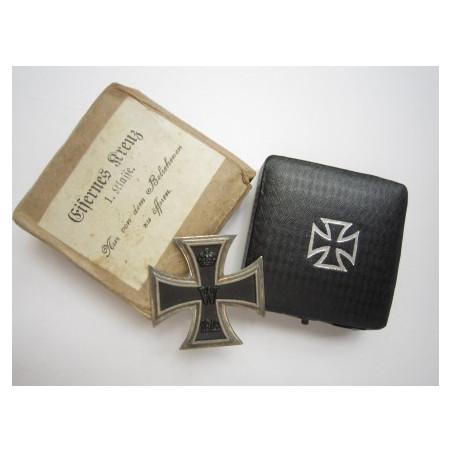
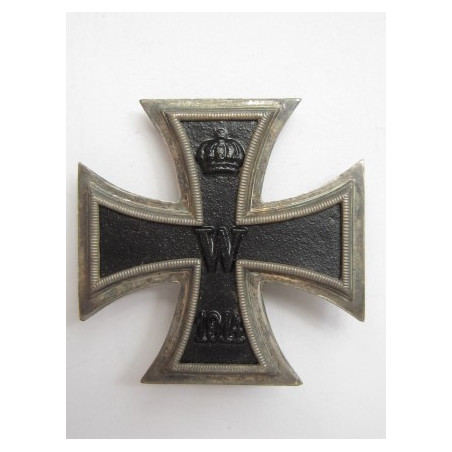
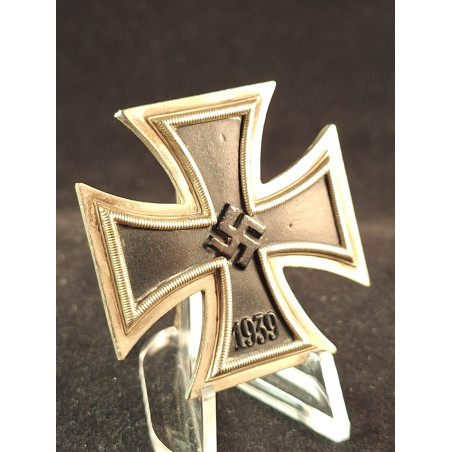
The Iron Cross (Eisernes Kreuz) is the best-known German military award. It was born in Prussia during the wars against Napoleon and renewed for each major conflict that followed, so a single shape, the black cross in a silver-coloured frame, spans several periods that a collector needs to tell apart.
Classes and models
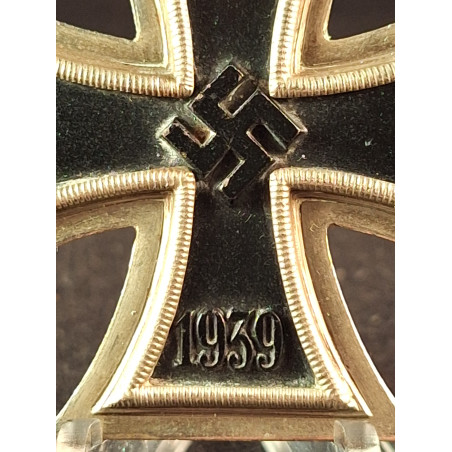
The Second Class cross (EK II) was worn from its ribbon, in the buttonhole or on a medal bar; the First Class cross (EK I) was pinned directly to the breast, with a pin or, on some privately purchased 1914 crosses, a screw-back. The Grand Cross was reserved for senior commanders. 1914 crosses show the crown, the "W" and the date on the obverse; 1939 crosses carry the date 1939 and the emblem of the regime at the centre, and the reverse of the EK II repeats the founding date, 1813. This collection brings together 1914 and 1939 crosses, Spangen and medal bars that include an Iron Cross; the 1914 crosses also have their own section: WWI Iron Cross.
How to identify an original Iron Cross
- Construction. Period crosses were made in three pieces: a blackened iron core held between the two halves of the frame. The core should attract a magnet and the frame seam should be clean.
- Markings. In 1914 there was no unified system: you find silver marks ("800", "935") and makers such as Wilhelm Deumer or Steinhauer & Lück. In 1939 many EK II carry a maker number on the ring ("4" Steinhauer & Lück, "100" Wächtler & Lange) and many EK I an "L/" code on the pin (L/11 Wilhelm Deumer, L/52 C. F. Zimmermann, L/59 Alois Rettenmaier). Many genuine crosses are unmarked: the lack of a mark is not, on its own, a sign of a fake.
- Common fakes. One-piece cast copies, non-magnetic cores, added marks and post-war pieces offered as period items. The 1957 pattern, with oak leaves in place of the central emblem, was legally made in the Federal Republic and must not be confused with the 1939 cross.
What is an Iron Cross worth?
There is no single price. Value depends on the period (1813 and 1870 crosses are far scarcer than those of 1914 and 1939), the class (the EK I is less common than the EK II), the maker and the rarity of the variant, the condition of core and frame, whether pin and catch are original and, above all, provenance: a cross with its case, its issue packet or the document that links it to a soldier is worth more than a loose piece. Sold items remain listed as a reference.
Crosses awarded to Spaniards of the Blue Division and the Blue Squadron are a chapter of their own. Browse all our German items and the WWII orders and crosses, and read our FAQ: every piece carries an authenticity guarantee with full refund and is shipped insured.